
For many years, there was one instrument in my 2006 Cirrus SR22-G2 that I had learned not to take too seriously: the right fuel gauge.
It wasn’t just slightly inaccurate, either. When both tanks were full, the left gauge would correctly show full, while the right one might indicate only half a tank. And as the fuel level dropped, things became even more interesting: with roughly half a tank remaining, the right gauge could already be sitting on empty.
Obviously, that is not something you particularly like to see in an airplane.
Of course, the obvious suspects had been investigated over the years. Both fuel sensors were changed, different gauges were tried, and quite a bit of troubleshooting went into the system. Nothing really solved the problem. The indication remained unreliable.
Yes, in an SR22 you can calculate your remaining fuel very accurately from the fuel flow and the amount you started with. And after flying the same airplane for many years, you also develop a pretty good feeling for its fuel consumption. But none of that changes the fact that a fuel gauge should tell you approximately how much fuel is actually in the tank.
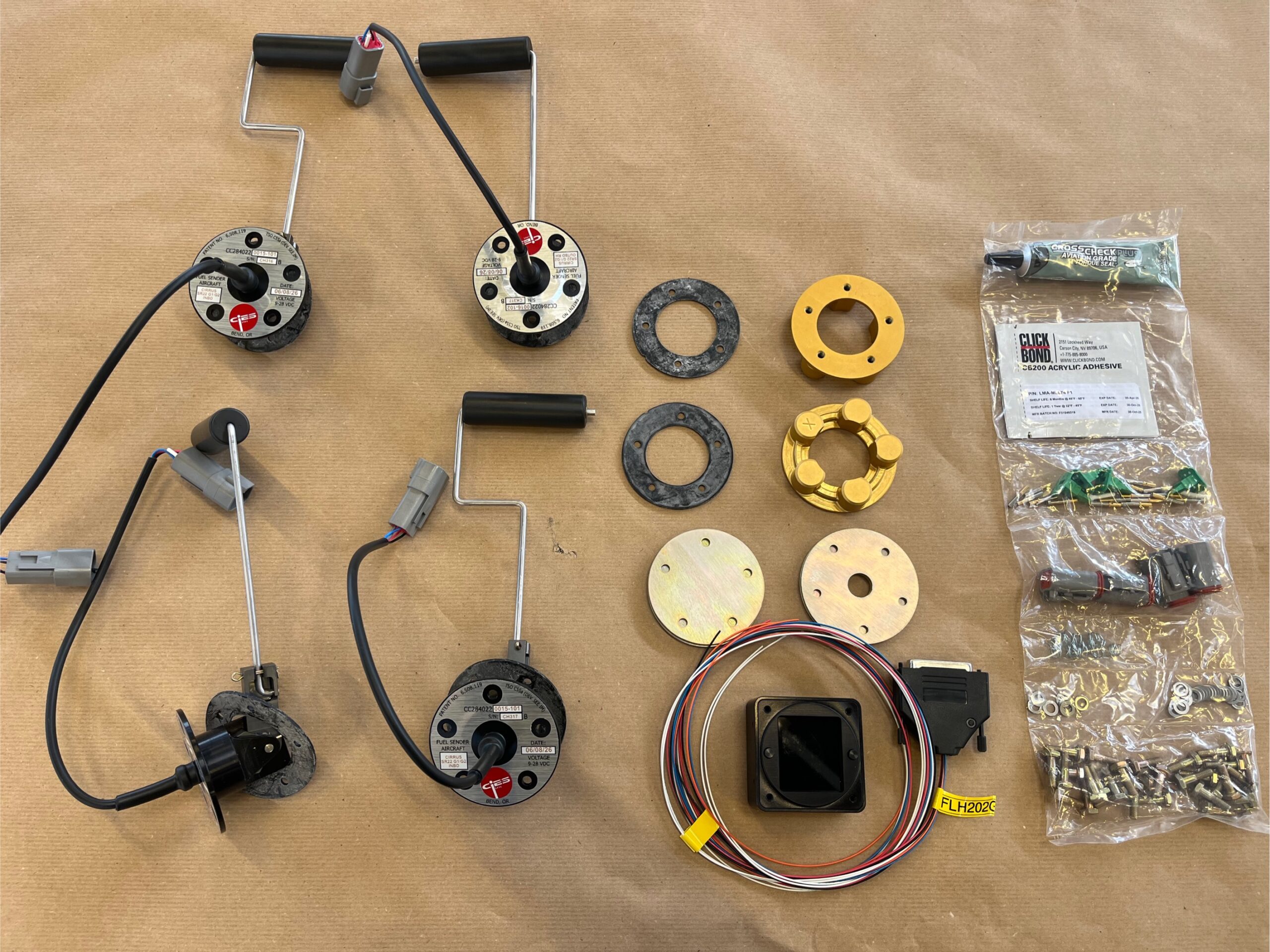
So eventually I decided to get rid of the old system and install CiES digital fuel quantity senders.
A different way of measuring fuel
The CiES system replaces the original fuel level senders with modern electronic fuel quantity sensors. They still use floats in the tanks, but instead of the traditional resistance-based sender with its mechanical electrical contact, CiES measures the position of the float arm using a magnetic field sensor.
In theory, this means much better repeatability and considerably less wear. More importantly for me, it offered the chance to finally have two fuel gauges that actually agreed with reality.
My Cirrus Service Center, AAS at Augsburg Airport, carried out the installation. My SR22-G2 became their first G2 on which they installed the CiES system, so the job was also something of a learning exercise.
And there is an important distinction here: installing CiES senders in a G2 is not the same job as installing them in a G3.
Why the G2 is more work than the G3
At first glance you might expect the installation to be basically identical. Both airplanes have two senders per wing, and CiES offers replacement senders for the G1, G2 and G3.
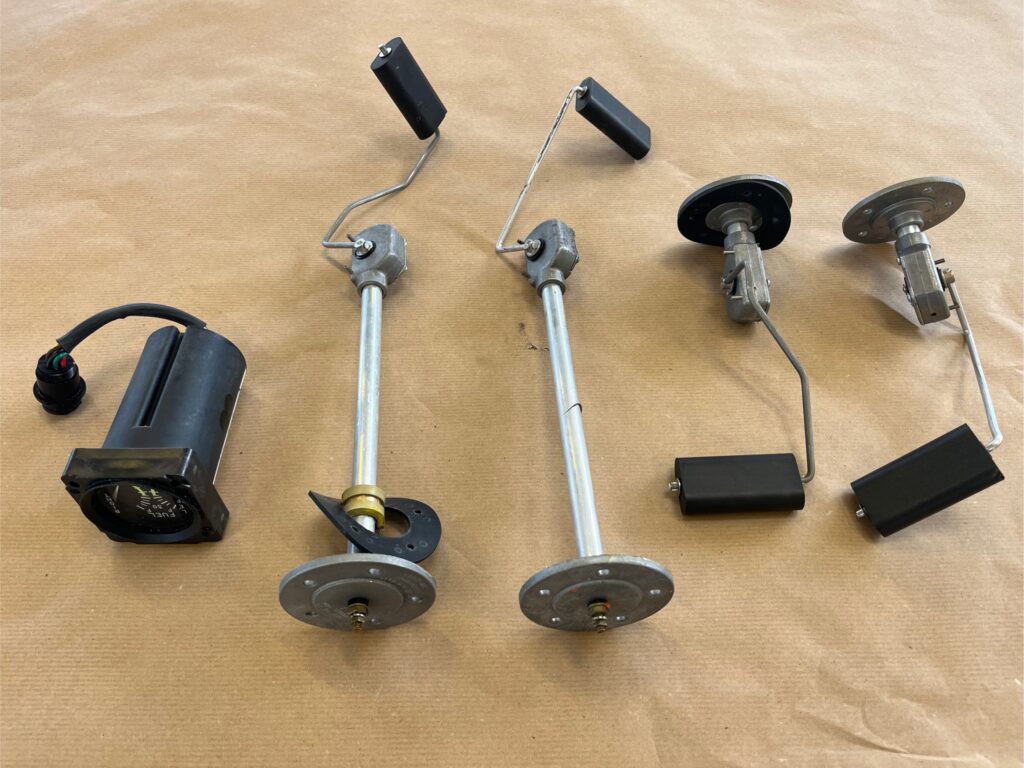
But the G1 and G2 installation is considerably more involved. On the G3, the CiES installation is essentially a much more straightforward replacement at the existing sender locations. On the G1 and G2, however, the inboard sender installation requires modification of the tank rib and the installation of a new mounting arrangement for the sender.
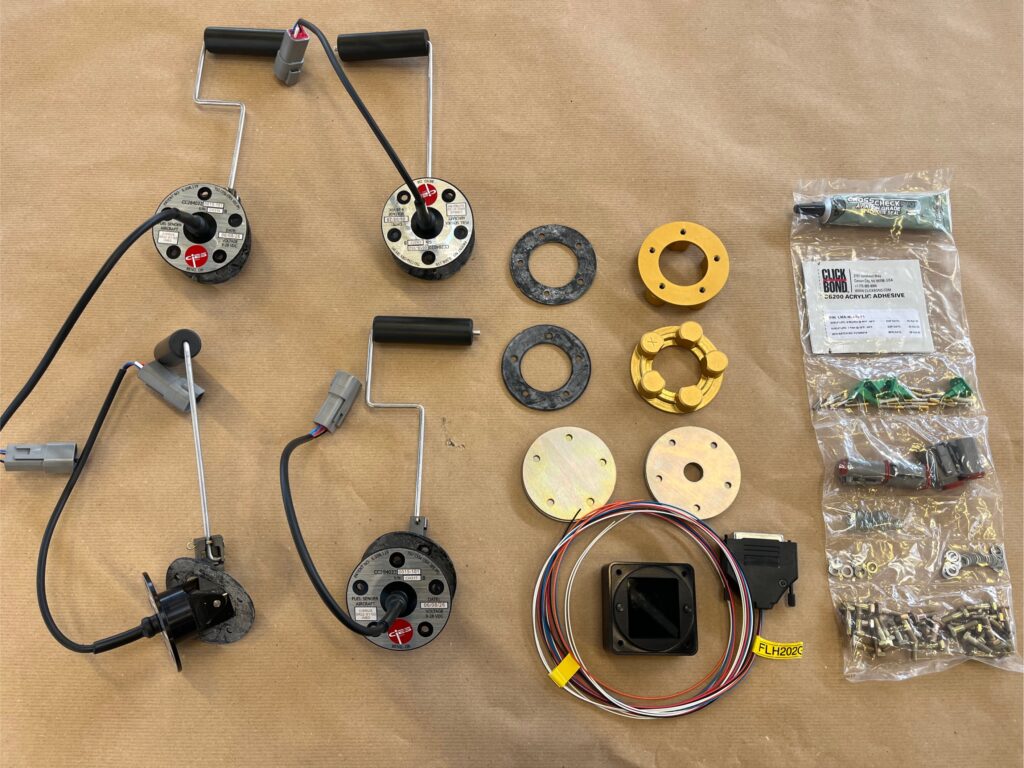
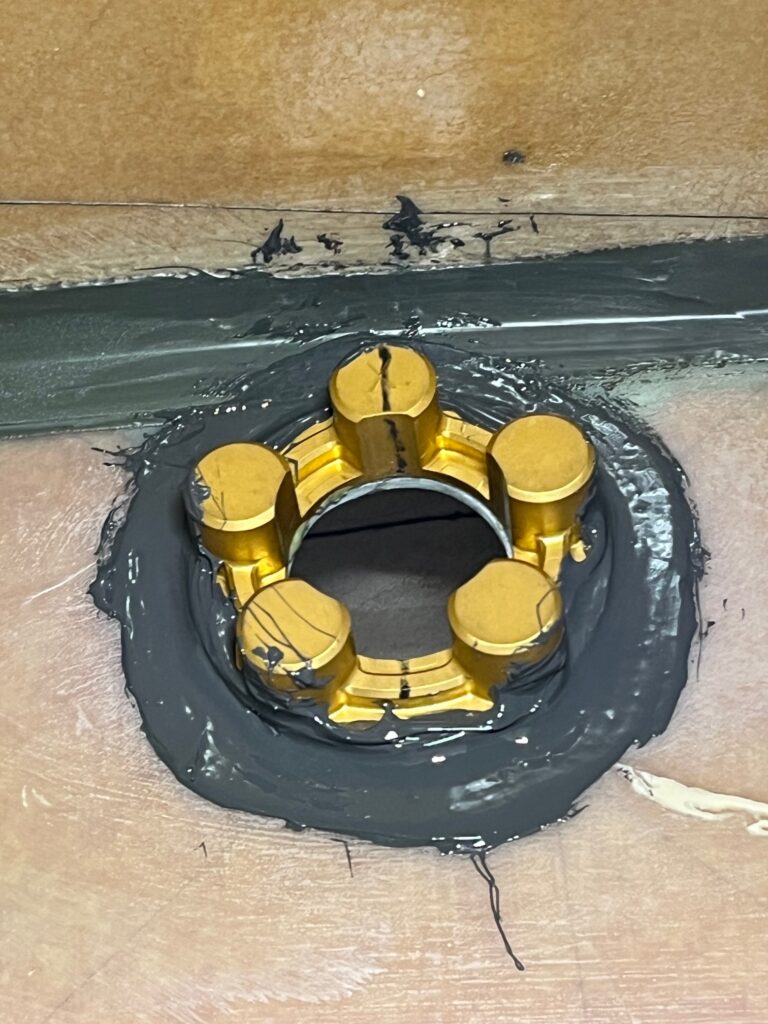
This means working inside the composite wing fuel tank, preparing the surface, drilling the new sender mounting pattern and bonding a nut ring into the structure. The bonded assembly then has to cure before the sender can finally be installed.
So if somebody tells you that installing CiES senders in an SR22 is a relatively simple job, it is worth asking which generation of SR22 they are talking about. On a G3 that description is much closer to reality. On a G2, there is quite a bit more involved.
And then there is the wiring.
New wires through the airplane
This was actually the part that took the longest on my airplane.
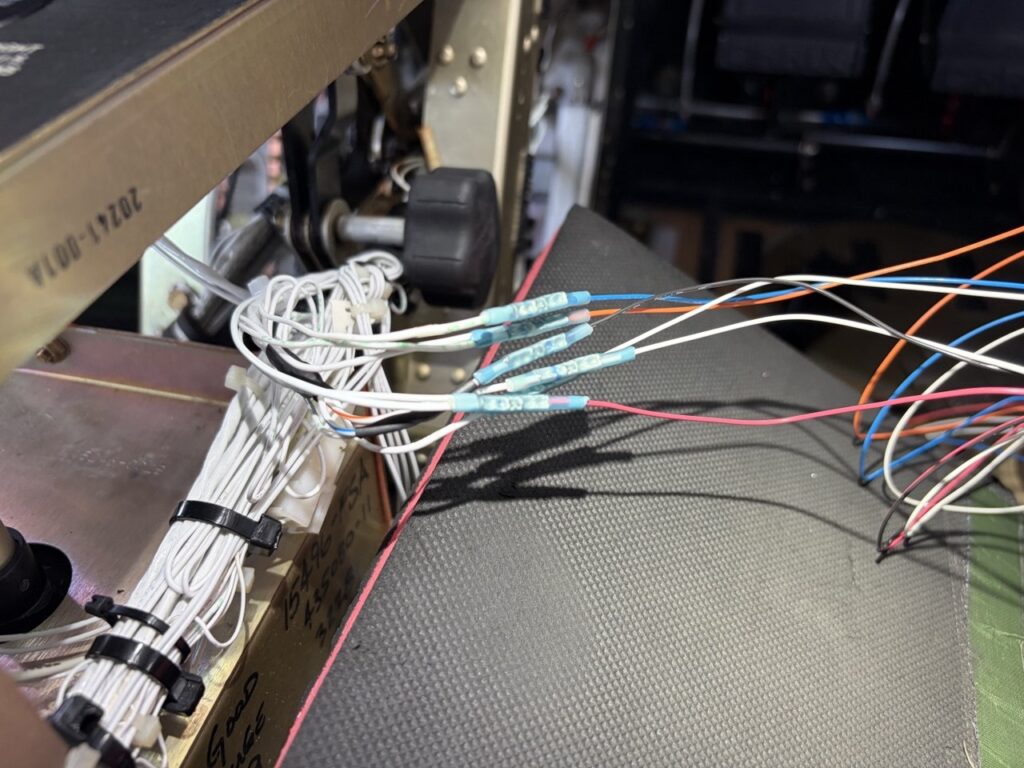
The original Cirrus senders are passive resistance devices. The CiES senders, on the other hand, are electronic and need electrical power. That means additional wiring has to reach the senders.In a G2, getting those new wires all the way through the wings and fuselage is not a five-minute exercise.
Anyone who has worked on an aircraft knows what that means. Running a wire through an already completed airplane can take considerably longer than installing the component at the end of it. Access is limited, existing wiring and systems have to be respected, and everything has to be routed and secured properly. In my installation, this consumed more working time than anything else.
One small problem with the new fuel gauge
There was another detail concerning the new digital AeroLogic FL202G fuel gauge which is worth mentioning, especially for anyone planning the same installation in an older Cirrus. The FL202G cannot simply be connected to the Cirrus instrument-lighting rheostat in the same way as the original fuel gauge. The dimming logic is reversed. In other words: turn up the brightness of the other instruments and the fuel gauge gets darker. Turn the instruments down and the fuel gauge gets brighter. Not exactly what you want at night.
The solution is actually quite simple. Instead of connecting the FL202G’s blue dimmer wire to the Cirrus rheostat, the fuel gauge can have its own small potentiometer installed in the center console. A suitable and inexpensive choice is the BOJACK B10K 3 potentiometer, which is available from Amazon for about €8.99. This gives the fuel gauge its own independent brightness control and avoids the reversed behavior of the original Cirrus lighting circuit.
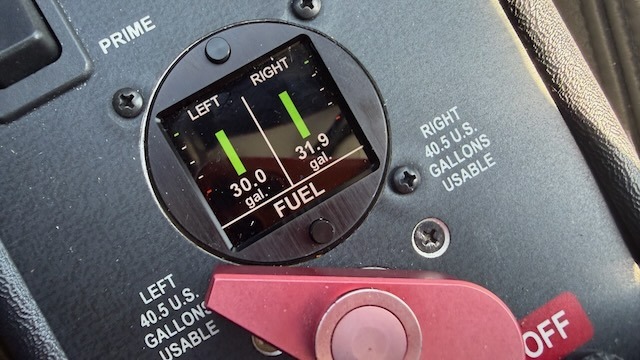
There is an even simpler solution if, like many owners, you practically never fly at night and don’t mind having the fuel gauge permanently bright: don’t connect the blue dimming wire at all. The FL202G has its own internal brightness adjustment. Set the gauge to the desired bright setting, save it, and leave it there. Done. It is a small detail, but exactly the sort of thing that is useful to know before doing the installation rather than discovering it afterwards.
Filling the tanks – very slowly
Once all four CiES senders were installed and the wiring was complete, there was still one very important job left: calibration. A fuel quantity system only becomes useful when it knows exactly what the sender positions mean in terms of actual fuel quantity.
The calibration therefore starts with the tanks essentially empty. First, the specified amount of unusable fuel is put into the tanks. This establishes the real zero point: the fuel that is physically in the aircraft but cannot be considered usable. From there, fuel is added progressively and the system is calibrated at the required points as the level rises.
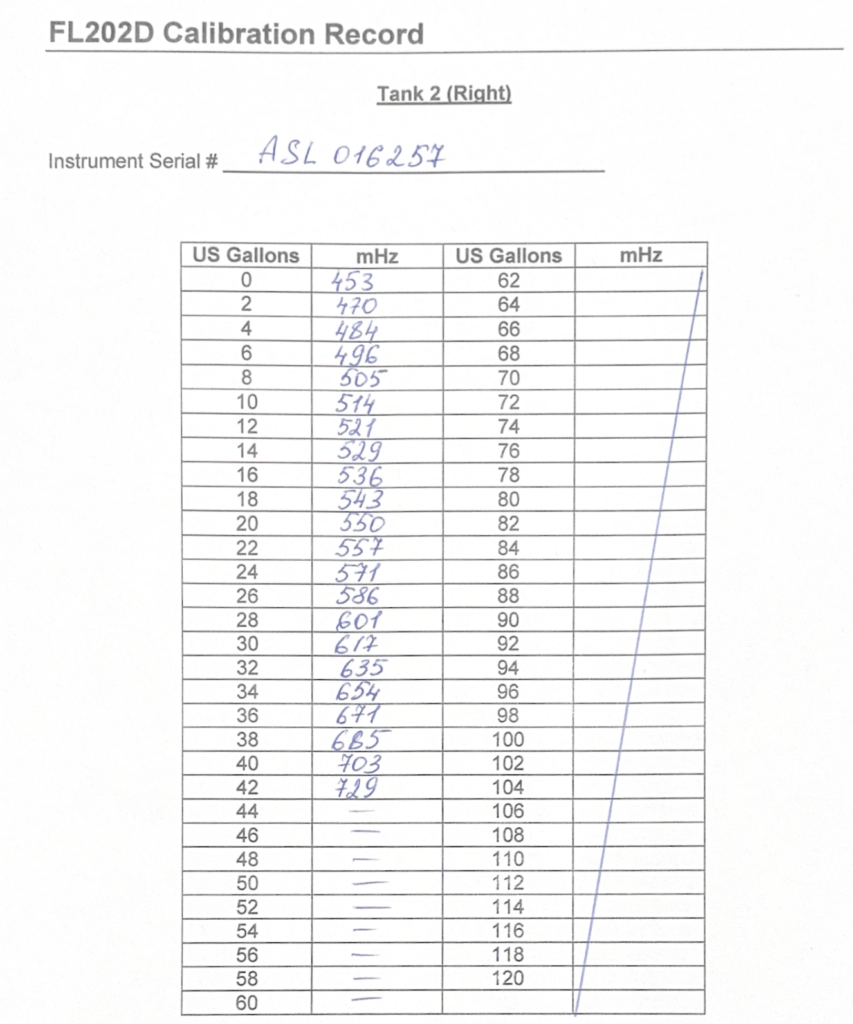
It is not particularly complicated, but it is a procedure that has to be done carefully. And there is something reassuringly fundamental about calibrating an aircraft fuel gauge this way: put a known amount of fuel into the tank and tell the system exactly what it is looking at. For years I had a right fuel gauge that could show half full when the tank was full and empty when there was still roughly half a tank remaining. We changed senders, tried different gauges and never really found a satisfactory solution.
The CiES installation in my G2 was certainly more involved than I had initially imagined. It required modifications at the sender installation, new wiring through the wings and fuselage, and finally a complete calibration of the system.
But after living with a basically useless right fuel indication for years, having a modern, properly calibrated fuel quantity system in the airplane is a very welcome upgrade.
So, how accurate is it?
The first tests have been quite impressive. The short answer is: VERY accurate.
With the tanks completely full, the digital gauges show between 40.5 and 41 gallons per side, which is exactly where they should be. More interesting, however, is what happens after actually flying the airplane.
After a couple of flights I refilled the tanks and compared three completely independent numbers: the fuel quantity indicated by the new CiES system, the fuel used according to the fuel totalizer, and the amount I had measured with my FuelStik. The amount of fuel required to top off the tanks matched all three remarkably well.
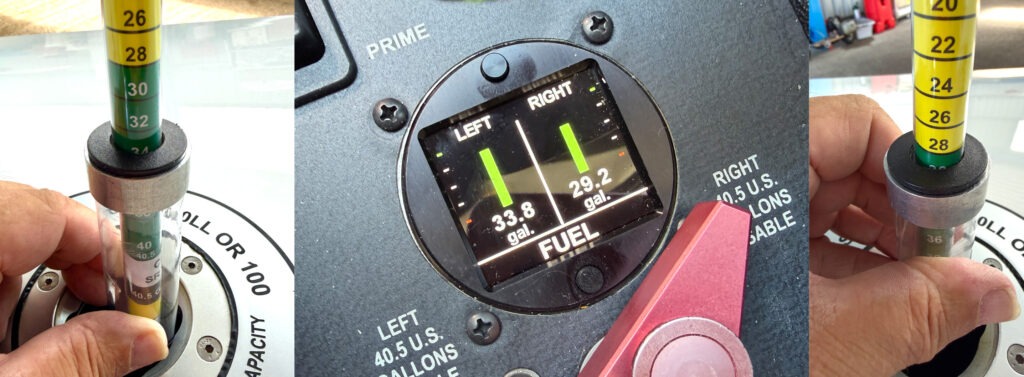
During the first weeks of flying with the new system, the CiES indication was never off by more than perhaps half a gallon. That is a completely different world from a gauge that previously indicated empty with something like half a tank still remaining.
Of course, a fuel totalizer remains an extremely useful instrument, and I will certainly continue using the Fuel Stik before flight. There is good reason for having several independent ways of knowing how much fuel you have. But it is very reassuring to look at the actual fuel gauges and discover that they now agree with the totalizer, the Fuel Stik and, ultimately, the amount of fuel that goes back into the tanks.
Sometimes the most satisfying improvements to an airplane are not the ones that add another colourful screen or another clever function. It is nice when “FULL” actually means full — and when 25 gallons apparently really means 25 gallons.
I’d make it less like a company profile and more like a short background section that naturally explains why the technology is relevant to your installation:
The CiES Company – A Better Way to Measure Fuel
The story behind CiES is actually quite interesting, because the company set out to solve a problem that almost every owner of an older light aircraft knows: fuel gauges that are somewhere between “approximately correct” and “don’t believe them at all.”
CiES Inc. is based in Bend, Oregon, and began developing a different approach to aircraft fuel measurement in 2003. Instead of trying to improve the traditional resistance-type sender, the company decided to get rid of one of its fundamental weaknesses: the electrical sliding contact.
The CiES sender still uses a float — there is no magic involved in determining where the surface of the fuel is — but the position of that float is measured differently. A permanent magnet moves with the float arm, while a contactless magnetic sensor detects its position. There is no resistive track and no electrical wiper moving across it. That has two obvious advantages. There is virtually no wear in the measuring mechanism, and the position of the float can be measured with much greater precision and repeatability.
After years of development and certification work, CiES brought its certified fuel senders to the General Aviation market in the early 2010s. Since then, the technology has found its way into a remarkably large number of aircraft. Today, more than 120,000 CiES senders are reportedly in service in over 50,000 aircraft worldwide, both as retrofit installations and as OEM equipment. There are FAA and EASA-approved installations for a long list of aircraft, including models from Cirrus, Cessna, Piper, Beechcraft and Mooney.
The man behind the idea is CiES founder Scott Philiben. His basic philosophy was quite simple: instead of accepting that inaccurate fuel gauges are somehow an unavoidable part of flying a light aircraft, why not use modern sensor technology to make them accurate?
That sounds obvious today, but for decades the standard answer to questionable fuel gauges was essentially to know how much you put into the tanks, use a fuel totalizer, check the tanks visually or with a dipstick — and don’t trust the gauges too much.
All of those habits are still good ones. I certainly have no intention of abandoning my fuel totalizer or my Fuel Stik just because I now have CiES senders.
But there is no particularly good reason why the fuel gauges themselves shouldn’t be accurate as well.
And after years of looking at a right fuel gauge in my SR22 that could indicate empty while there was still roughly half a tank of fuel remaining, that argument was rather convincing.
This version should fit particularly well just before “A different way of measuring fuel”—although I would then shorten that following section slightly to avoid explaining the magnetic sensing principle twice.
Check out the products CiES manufactures on their website where you will also find all user and installation manuals:
CiES Corporation
My CiES system was installed by the AAS Cirrus Service Center at Augsburg Airport (EDMA) in Bavaria.
Augsburg Air Service GmbH
Flughafenstraße 5
86169 Augsburg
Germany
