
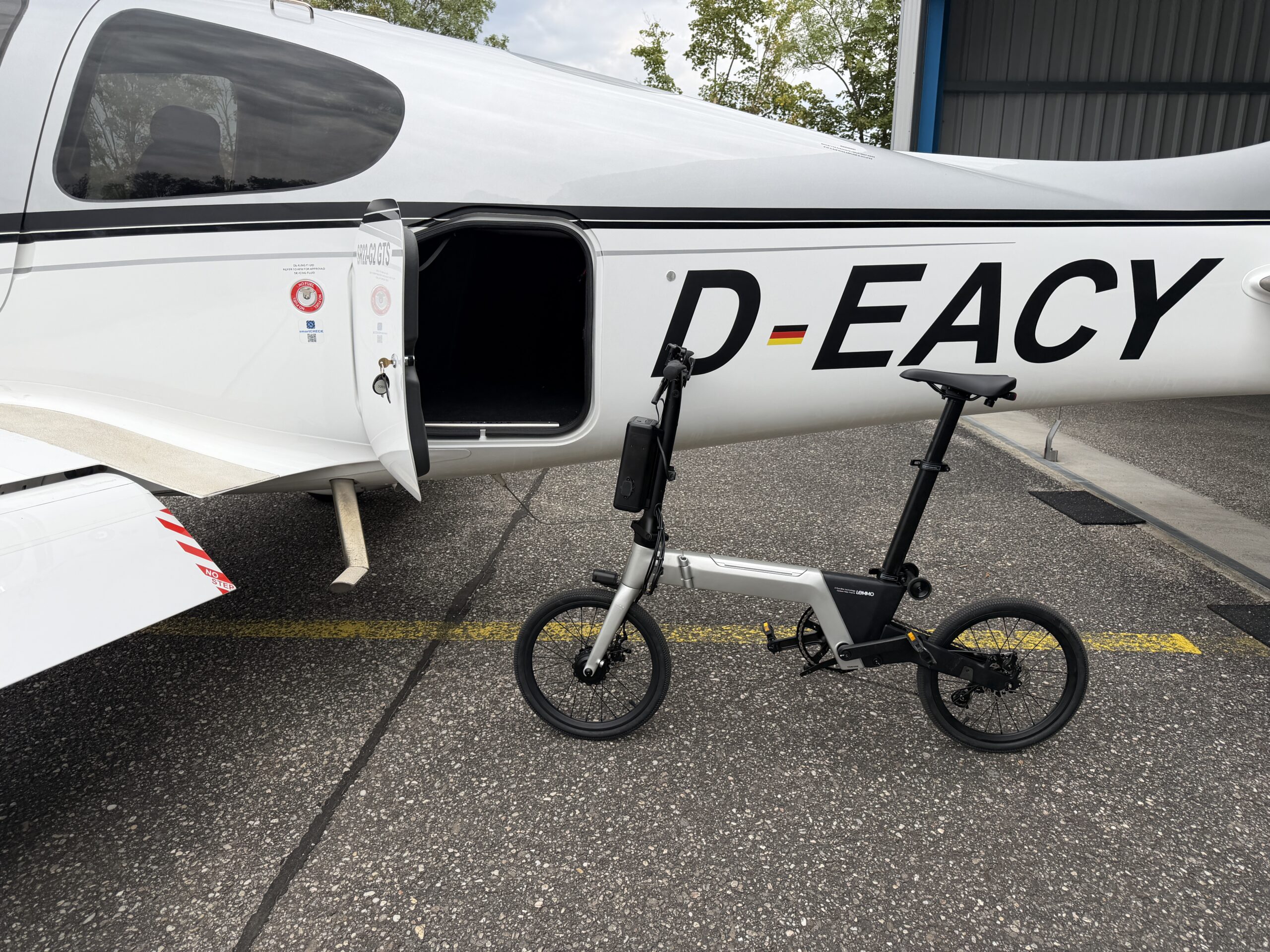
The LEMMO ZERO:
Ground transport solution for pilots
For private pilots, the problem of transportation often begins rather than ends after landing. Many smaller airfields are several kilometres from the nearest town, hotel or restaurant, while taxis and rental cars may be unavailable. A compact folding bicycle is an obvious solution – but carrying a conventional folding eBike in a light aircraft introduces two problems: weight and space. The Lemmo Zero addresses both remarkably well.
At the heart of the Zero is an aerospace-grade carbon-fibre frame and fork. The bicycle itself weighs approximately 11 kg, while the removable Smartpac Air battery and electronics module adds another 2.3 kg. More importantly for pilots, the Zero folds to just 590 × 515 × 250 mm. Lemmo says this corresponds to only 76 litres of volume and is small enough to fit into a conventional 28-inch suitcase. The three-part folding mechanism uses magnetic locking and can be folded in around 15 seconds.
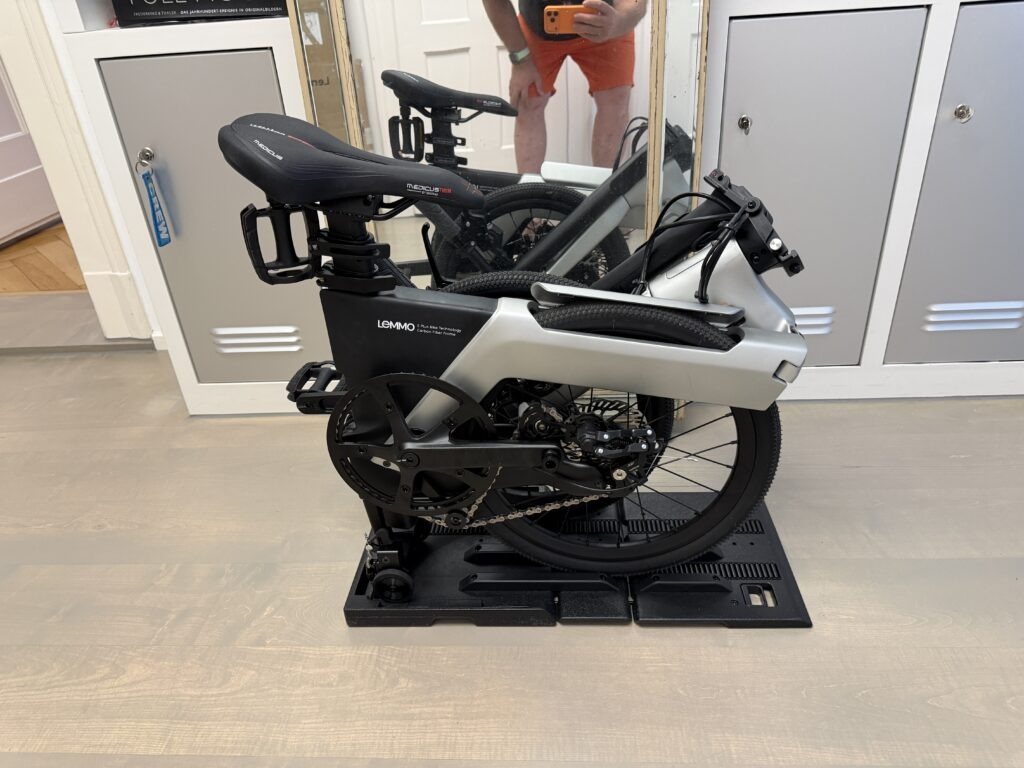
Those dimensions make the Zero particularly interesting for aircraft with limited baggage space. Instead of trying to squeeze a full-size bicycle through a baggage door, the folded Zero becomes a very compact rectangular package. After all the ZERO fits in a standard suitcase! Lemmo also offers a dedicated Zero Car Boot Holder, a compact mounting system into which the folded bicycle slides and locks automatically.
Although designed for automotive use, the concept is potentially attractive for aircraft baggage compartments as well: a properly installed and approved restraint arrangement could prevent a folded bike from moving around in turbulence or during acceleration and deceleration. Any installation in an aircraft would, of course, have to comply with the aircraft’s baggage-loading, restraint, weight-and-balance and certification requirements. The car boot holder is held in place by long stripes of velcro. It is a good idea to use additional straps to secure it in place.
If you don’t carry much baggage the baggage compartment of a Cirrus SR22 will easily hold two Zeros. And it is worth mentioning that without the battery pack the Zero will be a very good normal folding bike.
You are currently viewing a placeholder content from YouTube. To access the actual content, click the button below. Please note that doing so will share data with third-party providers.
An eBike with a Detachable Electric System
The most interesting feature for aviation use is Lemmo’s E+ dual-mode architecture. Instead of permanently integrating the battery into the frame, Lemmo places the battery and much of the electrical system in the removable Smartpac Air. Disconnect it and the Zero can be ridden much like a conventional lightweight folding bicycle. Attach it and the bike becomes a “pedelec”.
The Smartpac Air contains a 159 Wh lithium iron phosphate (LiFePO₄ or LFP) battery and weighs approximately 2.3 kg. This chemistry is particularly interesting from an aviation safety perspective. LFP is generally regarded as one of the safest mainstream lithium-ion battery chemistries, with substantially greater thermal stability and a lower susceptibility to thermal runaway than common high-energy chemistries such as NMC or NCA. Its thermal-runaway onset temperature is generally higher, and the chemistry is less prone to releasing oxygen internally as temperatures rise. In practical terms, this means a properly designed LFP battery has a lower fire risk than many other types of lithium-ion traction battery. It cannot, however, be described as fireproof: severe physical damage, electrical faults, improper charging or extreme heating can still result in a dangerous battery failure.
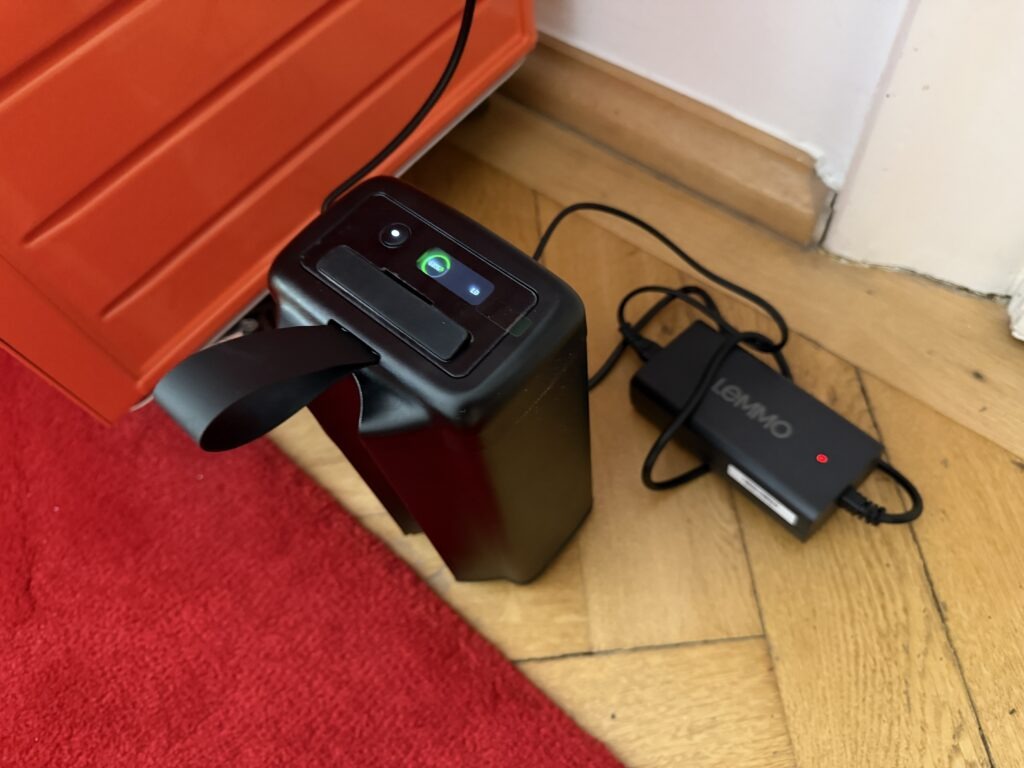
That distinction is particularly relevant in a light aircraft, where a battery fire in an inaccessible baggage compartment would be a serious emergency. The Zero offers two complementary advantages: it uses the comparatively thermally stable LFP chemistry, and the entire battery can be removed from the bicycle and carried separately in the cabin, where permitted. This allows the pilot to keep the battery accessible rather than burying it inside the baggage compartment (I also have a fireproof glove in the rear pocket of the right seat and a fireproof bag for small batteries).
Lemmo specifically describes the Smartpac Air as “flight-ready” and designed to be carried aboard aircraft. For airline travel, however, pilots should note that lithium-battery acceptance remains subject to the individual airline and applicable dangerous-goods rules; at 159 Wh, the battery exceeds the usual 100 Wh threshold for unrestricted passenger-carried lithium-ion batteries and may require airline approval. Some airlines prohibit eBike batteries altogether regardless of capacity.
For a private aircraft, removing the Smartpac offers another practical advantage: the 11 kg bicycle and 2.3 kg battery can be loaded separately, making both easier to handle and allowing the battery to remain accessible in the cabin where permitted by the aircraft’s operating limitations and applicable regulations.
Lightweight Electric Assistance
Once installed, the Smartpac powers a 36 V, 200 W motor through Lemmo’s unusual dual-mode rear hub. The motor assembly weighs only about 0.9 kg and produces up to 30 Nm of torque. A bottom-bracket torque sensor measures the rider’s input and adjusts assistance accordingly, with three assistance levels and support up to the European pedelec limit of 25 km/h. The five-speed derailleur uses a 49-tooth chainring and 11–19 tooth cassette.
The 159 Wh battery provides a claimed electric range of approximately 30–40 km depending on configuration and conditions, which is more than adequate for the typical “last mile” journey from an airfield into town. Charging takes around two hours. The Smartpac also doubles as a substantial power bank, offering USB-A and USB-C connectivity with up to 65 W USB-PD output—potentially useful for recharging a phone, tablet or other USB-powered equipment while travelling.
Despite its tiny folded dimensions, the Zero uses 16 × 1⅜-inch wheels and has an approximately one-metre wheelbase. Lemmo says its geometry provides a riding position comparable to a conventional 26-inch bicycle. Mechanical disc brakes are fitted front and rear, while integrated Bluetooth, GNSS/GPS, LTE connectivity and the Lemmo smartphone app provide navigation and ride information.
For the private pilot, this combination is unusually compelling: 11 kg of bicycle, a separately removable 2.3 kg LFP electrical system, a 590 × 515 × 250 mm folded package, roughly 30–40 km of assisted mobility and a dedicated storage holder. Land at a remote airfield, secure the aircraft, remove the Zero from the baggage compartment, take the Smartpac from the cabin, attach it to the bike and ride into town.
In other words, the Lemmo Zero isn’t merely a folding eBike. For pilots of touring aircraft with limited payload and baggage volume, it can function almost like a personal ground-transport module carried aboard the aircraft—and its removable, comparatively fire-resistant LFP battery chemistry makes it particularly well suited to the special safety considerations of general aviation.
The official unboxing video:
You are currently viewing a placeholder content from YouTube. To access the actual content, click the button below. Please note that doing so will share data with third-party providers.
The company’s website and contact data:
https://www.lemmofuture.com/de/pages/lemmo-zero
